




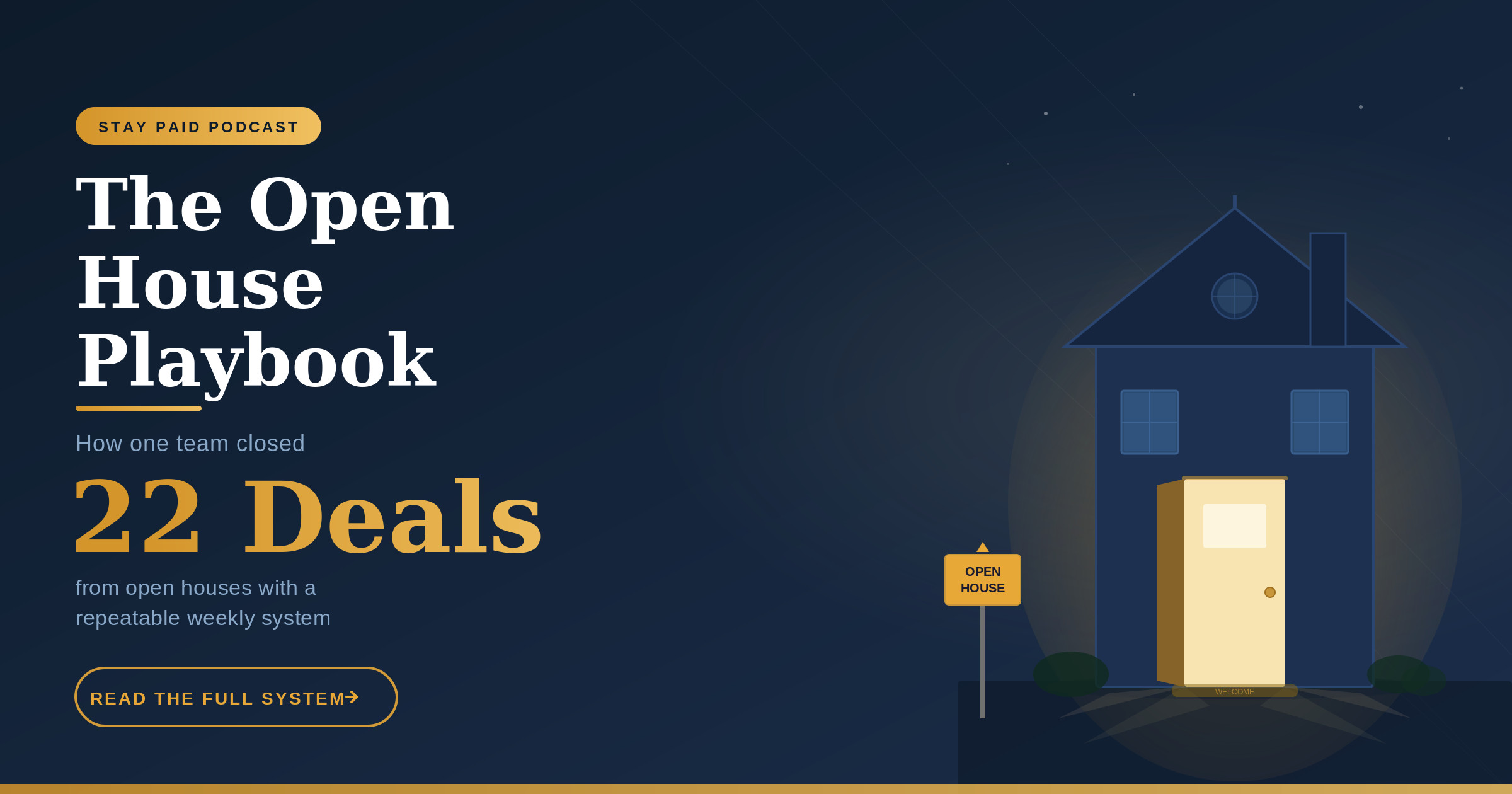
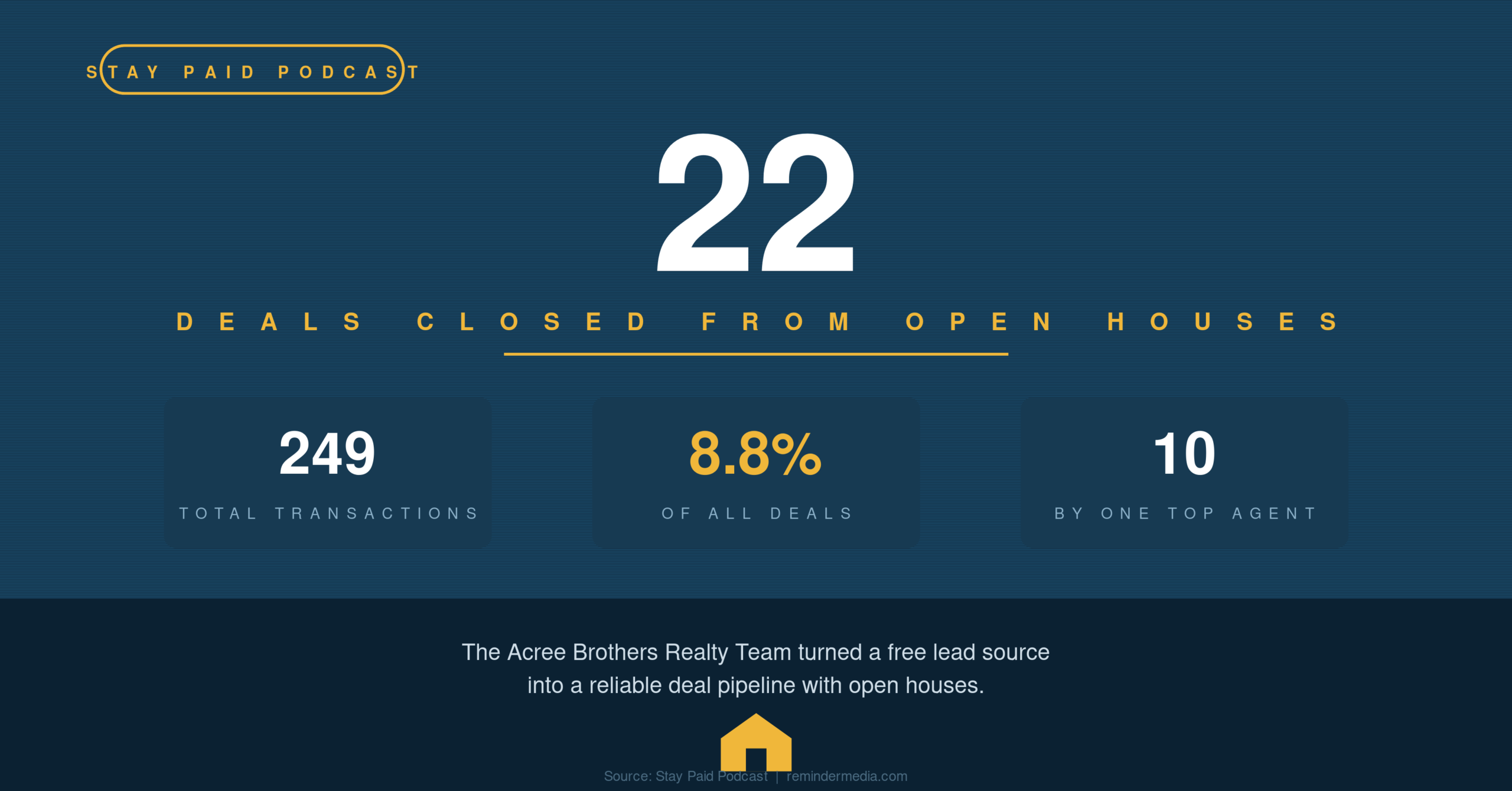
Out of 249 total transactions last year, the Acree Brothers Realty team in Lynchburg, Virginia, closed 22 deals that originated from open houses. One agent on the team, Tim, accounted for 10 of those by doing what most agents won’t: holding open houses consistently, week after week, and following a system that turns casual visitors into signed clients.
That’s not a fluke. It’s a standard operating procedure — and it’s one you can replicate in your own market.
On the Stay Paid podcast, team members Stephen Acree and Cody Smith broke down their entire open house system: how they choose which listing to hold, how they market it, what happens the day of, and how they follow up to convert leads into closings. Here’s the full playbook.
Why Open Houses Are Still One of the Best Free Lead Sources for Real Estate Agents
Open houses are one of the few truly unpaid, inbound lead sources left in real estate. You’re not paying for Zillow leads. You’re not running Facebook ads. You’re investing your time — sweat equity — to get in front of people who are actively out looking at homes.
That makes open house leads fundamentally different from most other sources. These are bottom-of-funnel prospects: they got in their car, drove to a property, and walked through the door. The intent is already there.
One podcast guest shared an even more dramatic example: a team doing five to seven open houses per week generated 75% of their 225 deals for the year entirely from open houses. While not every market supports that volume, the principle holds — agents who hold open houses consistently and follow up systematically close more deals than those who treat them as occasional events.
How to Choose the Right Listing for Your Open House
The listing you choose determines how many people walk through the door. Not every property is worth the time investment, and top-producing agents are deliberate about which homes they hold open.
Two factors matter most: price range and competitive pricing. Choose a listing in the price range where you want to build your business, and make sure the home is priced competitively for its market. A well-priced home draws more traffic. An overpriced home in a slow neighborhood won’t generate the foot traffic you need to make the time worthwhile.
What if you don’t have your own listings?
Build relationships with other agents — even outside your brokerage. Offer to hold their open houses and earn their trust through exceptional follow-up. After each open house, text the listing agent within an hour with how many people came through and what feedback you collected. This level of communication is so rare that it generates referrals on its own.
As Cody Smith shared on the podcast, the number one solo agent in Lynchburg started referring him to other top agents specifically because of how well he communicated after holding their open houses. That kind of reputation compounds fast.
Pro Tip: If you’re just starting out, don’t wait for your own listings. Approach top agents in your office, offer to hold their open houses, and treat the listing agent like a client. Your follow-up with them is just as important as your follow-up with the visitors.
The Weekly Open House Cadence That Produces Results
Top-performing agents on the Acree Brothers team hold one to two open houses per week per agent. But the preparation doesn’t start when you unlock the front door on Sunday. It starts four days earlier.
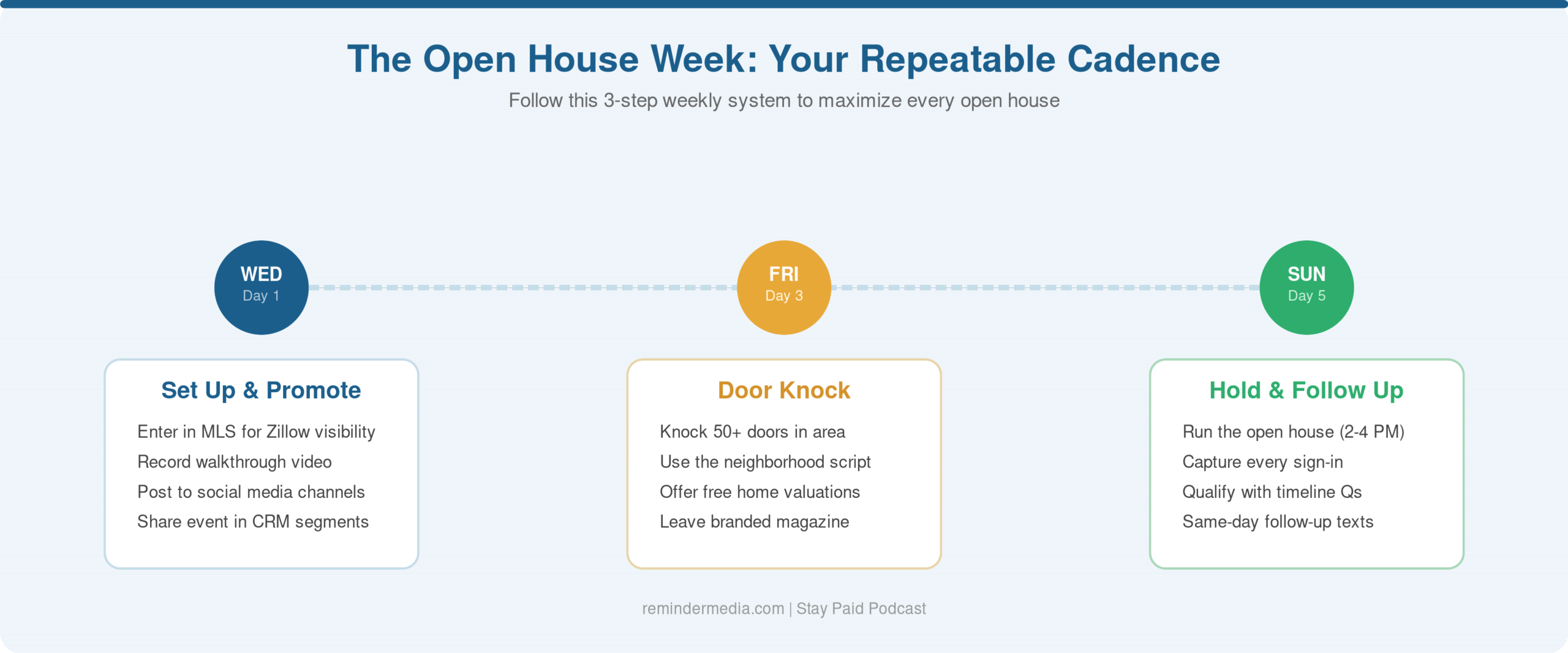
Wednesday: Set Up and Create Content
Enter the open house in your MLS so it appears on Zillow, Realtor.com, and other portals before the weekend. Most buyers search online before deciding which open houses to visit, so early MLS entry is critical. Then record a quick walkthrough video or social media reel promoting the event. Share the property, the time, and what makes it worth visiting.
Friday: Door Knock the Neighborhood
This is where most agents leave money on the table. Two days before the open house, knock on doors in the surrounding neighborhood. The open house gives you a natural, low-pressure reason to be there — you’re not cold-calling out of nowhere. You’re being a good neighbor by letting people know about the event.
Sunday: Hold the Open House and Collect Data
Show up prepared. Run a CMA on the property as if you were presenting it to a buyer, even if it’s not your listing. Know the home’s details — roof age, HVAC updates, square footage, school district. Being the expert builds trust immediately with every visitor who walks in.
The Door-Knocking Script That Generates Listings and Leads
Door knocking before an open house is one of the most effective prospecting techniques in real estate because you have a built-in reason to knock. You’re not selling. You’re informing. That changes the entire dynamic of the conversation.
Here’s the approach that the Acree Brothers team uses, as shared on the Stay Paid podcast:

Step 1 — The Neighborly Heads-Up: Let them know you’re holding an open house nearby so they’re aware of extra cars. This is low pressure — you’re informing, not selling.
Step 2 — Ask for Neighborhood Intel: Ask what they love about the neighborhood. This disarms the homeowner, makes them feel valued, and gives you genuine content to share with open house visitors.
Step 3 — Offer a Home Valuation: Mention that you’ve been running numbers on homes in the area for the open house and ask if they’d like to know what their home might be worth. Every homeowner wants to know, and it creates a follow-up reason.
Step 4 — Introduce Your Leave-Behind: Tell them you send a free magazine to homeowners in the area with recipes, home tips, and local info. Ask if you can add them to the list. This positions your personally branded magazine as a natural touchpoint that keeps you top of mind long after the conversation ends.
This script isn’t about being pushy. It’s about leading with value at every step — and each step naturally creates a reason for future contact.
Day-of Open House Strategy: How to Maximize Every Visitor
The agents who close deals from open houses treat the event like a structured sales process — not a casual afternoon of waiting around for visitors to wander in.
Get everyone signed in — no exceptions
Set up a sign-in station right at the front door, ideally with a laptop running a Google Form connected to your CRM. When visitors arrive, greet them warmly, make brief small talk to break the ice, then direct them to sign in before exploring the home. If anyone hesitates, use this framing: “The seller wants to know everyone who’s come through — just like you’d want to know if this were your home.” It’s honest, reasonable, and almost no one says no.
Ask the right qualifying questions
Before they walk the home, ask: “How long have you been looking?” This single question reveals more than almost anything else. New buyers likely aren’t signed with an agent yet — they’re prime prospects. Long-time lookers might already have representation, or they might be stuck and need help. Either way, the answer tells you exactly how to follow up.
The second critical question is about their timeline. But remember — whatever timeline a buyer gives you, experienced agents know to cut it in half. A buyer who says “six months” often means three. The only thing stopping them is finding the right home.
Don’t follow visitors around the house
Give them space to explore. But be strategically positioned near the exit so you can catch them on the way out for feedback. Ask what they thought, what they liked, and what didn’t work. If they start picking the house apart, that’s actually a strong buying signal — serious buyers scrutinize. Casual browsers just say “love it” to everything.
Counterintuitive insight from the Acree Brothers: The visitors who are most friendly and chatty are usually not the serious buyers. Serious buyers feel the pressure of a real decision, so they’re more guarded. Don’t spend all your time with the friendly talker while the quiet couple slips out the door.
Use off-market deals as your hook
Before the visitor leaves, plant this seed: “Just so you know, a lot of the best deals in this area never make it to the MLS. I have access to off-market properties and can send you some options that match what you’re looking for.” Over 50% of buyers say they want their agent to find them a property — and off-market access is something Zillow can’t offer. It creates immediate value and gives you a concrete reason to follow up.
The Open House Follow-Up System That Converts Leads into Clients
The open house itself is just the beginning. The real deals are closed in the follow-up — and the agents who win are the ones who follow up fastest and most consistently.
Speed to lead: Follow up the same day
Contact every attendee the day of the open house while you’re still fresh in their memory. A quick text with a property recommendation shows you were paying attention and that you work hard for your clients. Don’t wait until Monday. By then, another agent may have already reached out.
Send properties — even imperfect ones
For leads who are actively searching (six months or less), send property recommendations right away. Include off-market deals if you have them. But here’s the advanced move: also send properties you know aren’t a perfect fit, and explain why. Something like, “I know this one’s a bit smaller than what you mentioned, but it has that open-concept layout you liked. Feel free to tear it apart — your feedback helps me narrow in on exactly what you’re looking for.” This shows you listened, keeps the conversation going, and makes the lead feel understood.
Expect a longer close timeline
In the current market, agents report that open house leads are taking an average of six months to close — longer than in previous years. That makes consistent follow-up even more essential. Use a CRM to set tasks, track touches, and ensure no lead falls through the cracks. The agents who close from open houses aren’t the ones who give up after two weeks of no response. They’re the ones who keep showing up in a lead’s inbox, month after month, with relevant value.
And remember this insight from the Stay Paid podcast: people who are going to buy often won’t answer the phone. They’re not ignoring you — they’re waiting until they’re ready. Your follow-up isn’t annoying them. It’s keeping you in position for when the moment arrives.
Frequently Asked Questions About Real Estate Open House Strategy
How many deals can you realistically close from open houses?
One real estate team closed 22 deals from open houses out of 249 total transactions in a single year. Their top-performing agent accounted for 10 of those 22 by holding one to two open houses per week and following a consistent system for sign-ins, data collection, and follow-up.
What is the best day and time to hold an open house?
Sunday afternoons remain the most popular, but preparation starts earlier in the week. A proven cadence is: Wednesday for MLS entry and social media video, Friday for neighborhood door knocking, and Sunday for the open house. Entering the open house in MLS early ensures it shows up on Zillow and other portals before the weekend.
What should you say when door knocking before an open house?
Lead with a neighborly heads-up, not a sales pitch. Let them know you’re holding an open house nearby so they’re aware of extra cars. Ask what they love about the neighborhood — this provides listing intel and builds rapport. Then offer a free home valuation and introduce a leave-behind like a personally branded magazine to stay in touch.
How do you follow up with open house leads?
Speed to lead is critical — follow up the same day. Send properties that match their criteria, including off-market opportunities. For leads who aren’t ready to buy immediately, send properties you know aren’t a perfect fit along with a note explaining what you remembered about their preferences. This proves you listened and keeps the conversation going.
Do open houses still work for generating buyer leads?
Yes. Open houses are one of the few free, inbound lead sources for real estate agents. They produce bottom-of-funnel leads — people actively looking at properties. While close timelines have extended to about six months in the current market, agents who hold open houses weekly and follow up consistently report strong, measurable results.

Turn Open House Contacts into Clients for Life
An open house gets you in front of buyers. But the relationship you build after the open house is what determines whether they choose you — or the next agent who shows up in their inbox.
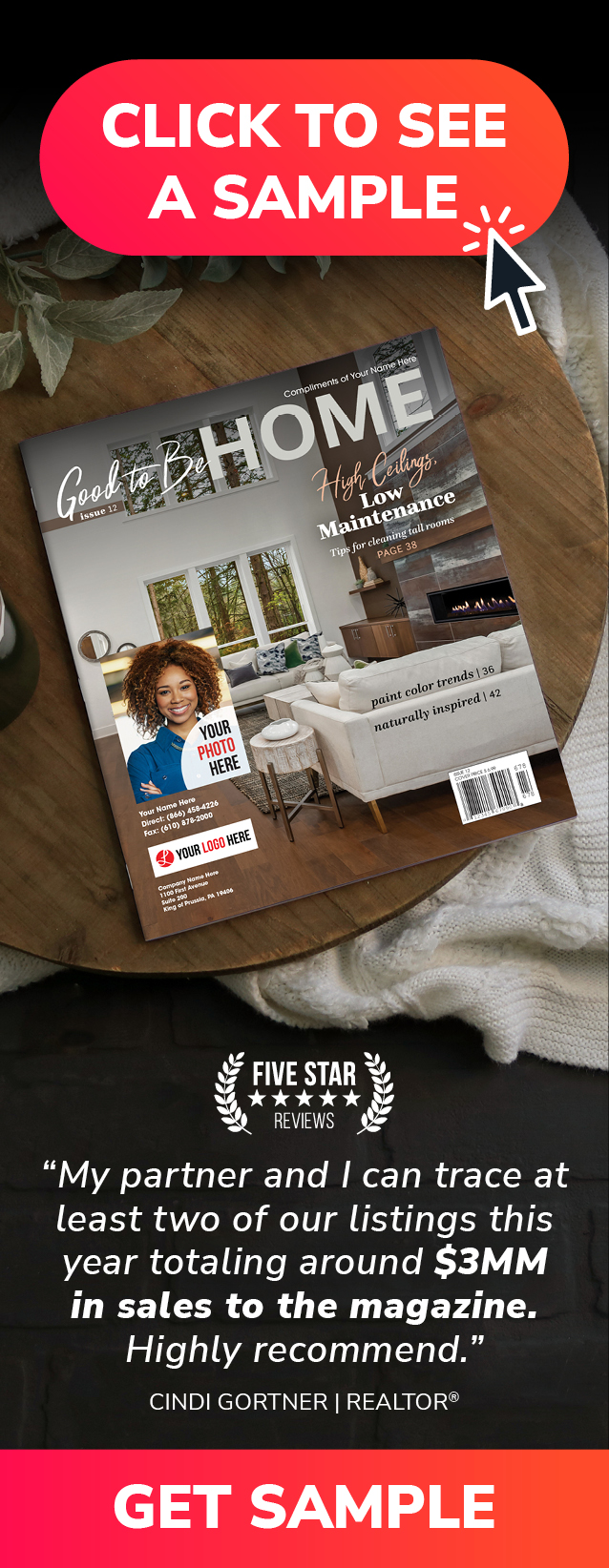
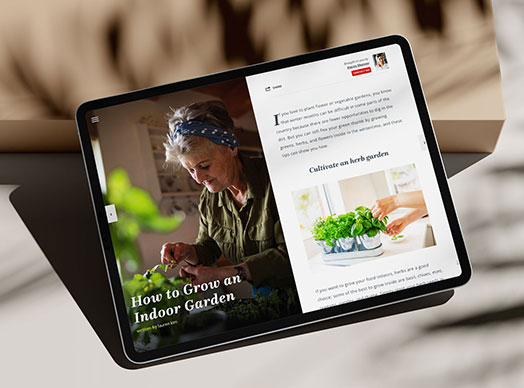
The top-producing agents on the Acree Brothers team don’t just follow up with texts and calls. They stay visible in their prospects’ homes with a personally branded magazine — a 48-page, coffee-table-quality publication that recipients keep for four to ten weeks. It’s not a postcard that gets tossed. It’s a tangible, valued touchpoint that keeps you top of mind between conversations.
Ready to build your open house system? Download the free ReminderMedia Open House Kit at remindermedia.com/openhouse — including sign-in sheets, Canva templates for signage, and the Acree Brothers’ open house SOP.
Listen to the full episode: Open Houses: The EXACT Plan That Closed 22 Deals on the Stay Paid Podcast.